
Your Apple Watch Series 6 sits motionless on the charger—no green lightning bolt, no response, just silence. You press the Digital Crown or side button, but the screen remains black. If you depend on your watch for heart rate monitoring, sleep tracking, or staying connected, this is more than inconvenient—it’s alarming. But before you assume the worst, know this: an Apple Watch 6 won’t charge is a surprisingly common issue, and in most cases, it’s fixable.
The problem might be as simple as a dirty charging port or a faulty cable. Or it could stem from deeper issues like battery degradation, software glitches, or hardware failure. The good news? There’s a clear, step-by-step path to diagnosing and fixing it. Whether your watch shows a red lightning bolt, gets unusually hot during charging, or refuses to wake up after months in a drawer, this guide delivers proven solutions used by thousands of users and Apple support professionals. You’ll learn how to interpret charging symbols, revive a dead battery, bypass software freezes, and when it’s time to seek repair.
Decode What the Charging Lights Mean

Red Lightning Bolt: Battery Is Fully Drained
When you see a red lightning bolt, your Apple Watch Series 6 has entered Power Reserve mode—its battery is completely empty. It won’t turn on or respond until it receives enough charge. Once placed on the charger, the symbol should change to a red lightning bolt inside a ring, signaling that charging has begun.
If the ring doesn’t appear within 30 minutes, don’t give up. A deeply discharged battery—especially after long storage—can take several hours to show signs of life. Apple recommends leaving it connected for at least 8 hours before concluding it’s not charging.
Pro Tip: Even brand-new watches can arrive in this state after being shipped or stored for weeks. Patience is key.
Green Lightning Bolt: Charging But Possibly Failing
A green lightning bolt means the watch detects the charger and is attempting to charge. But if the device heats up, shuts down, or stops charging after a few minutes, there’s likely an underlying issue—such as battery degradation, a failing charging circuit, or internal damage.
Heat is a major red flag. If your watch becomes warm to the touch, disconnect it immediately. Lithium-ion batteries can overheat dangerously if damaged or improperly connected.
Black Screen: Not Always a Sign of Death
A blank screen doesn’t mean your watch is broken. If the battery is fully drained, it may take 10 to 30 minutes—or even longer—before any visual feedback appears. Apple advises waiting at least 30 minutes on a proper charger before assuming failure.
Avoid constantly plugging and unplugging. Let the watch sit undisturbed to allow the battery to stabilize.
Start with the Charger and Cable
Use Only Apple-Certified Charging Accessories
Third-party cables may look identical but often lack proper magnetic alignment or power regulation. Stick to the Apple Magnetic Charging Cable or USB-C Magnetic Fast Charging Cable. Many “won’t charge” cases vanish after switching from a cheap knockoff to an official Apple charger.
If you’re using a non-Apple cable, replace it immediately. Even slightly misaligned magnets can prevent a secure connection.
Test with a Different Charger and Power Adapter
Faulty hardware is one of the top causes. To pinpoint the issue:
- Try a known-working Apple charger.
- Test your cable on another Apple Watch.
- Plug into a different wall outlet.
This process helps determine whether the problem lies with the watch, cable, or power adapter.
Plug Into a Wall Outlet, Not a Computer
Avoid charging from:
– Laptops (especially in sleep mode)
– USB hubs
– Power banks
– Low-power USB ports
Instead, use a wall outlet with an Apple 5W, 12W, or 20W USB power adapter. For stubborn cases, try an iPad 20W charger—while the Apple Watch doesn’t fast charge, higher-wattage adapters can help initiate power delivery on deeply drained batteries.
Note: Never use damaged or frayed cables. Even minor wear can interrupt charging.
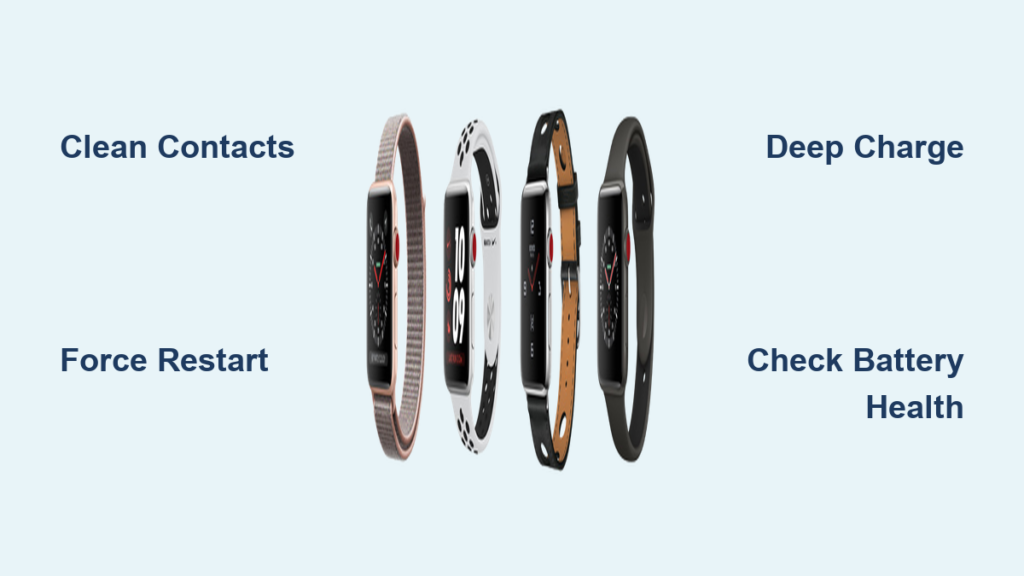
Clean the Charging Contacts Thoroughly

Remove Dirt, Sweat, and Lint Buildup
The metal contacts on the back of the watch and the magnetic surface of the charger are prone to collecting dust, sweat, lotion, and lint. This grime creates a barrier that blocks electrical contact—even if the watch snaps into place magnetically.
To clean safely:
1. Power off the watch if possible.
2. Use a dry, lint-free microfiber cloth or soft-bristled brush.
3. Gently wipe both the watch back and charging puck.
Never use:
– Liquids or cleaning sprays
– Compressed air (can push debris deeper)
– Sharp objects (risk of scratching)
Common Mistake: Users often assume the connection is fine because the watch “sticks” to the charger. But unseen residue can still break the circuit.
Ensure Proper Magnetic Alignment
Snap the Watch Firmly Into Place
The Apple Watch Series 6 relies on precise magnetic alignment. If it’s not seated correctly, charging won’t start.
Steps to ensure proper contact:
– Place the charger on a flat, stable surface.
– Position the watch so it snaps securely into place.
– For 44mm or 45mm models, make sure the charger isn’t tilted.
If using a Magnetic Charging Dock or MagSafe Duo, remove thick or metal bands that might interfere with alignment.
Visual Cue: You should feel a firm magnetic pull. If it feels loose, reposition.
Force Restart to Clear Software Glitches
Hold Side Button + Digital Crown for 10 Seconds
A frozen or unresponsive watch may not charge, even when connected. A force restart can clear temporary software bugs.
Steps:
1. Press and hold the side button and Digital Crown together.
2. Hold for at least 10 seconds.
3. Release when the Apple logo appears.
Wait 2 minutes before placing it back on the charger. Many users report their watch starts charging immediately after this step.
Pro Tip: If the screen flickers or shows a low-battery clock face, let it sit on the charger undisturbed for 1–2 hours.
Update watchOS to Fix Charging Bugs

Install the Latest Software via iPhone
Outdated watchOS versions can cause charging issues. Updates often include fixes for battery and power management.
To update:
1. Open the Watch app on your iPhone.
2. Go to General > Software Update.
3. Download and install any available updates.
The watch must be charging or have over 50% battery during the update. If it won’t charge, complete other fixes first—especially force restart and extended charging.
Leave It on Charger for 8 to 10 Hours
Give a Dead Battery Time to Wake Up
If your Apple Watch 6 shows no signs of life, leave it connected for 8 to 10 hours, even overnight. A deeply discharged battery may take hours to respond.
Real user reports:
– One watch revived after 5 hours.
– Another came back after 4 days with 13% battery.
– A stored unit (unused for 2+ years) failed—indicating permanent battery failure.
Patience is critical. Don’t assume it’s dead after 30 minutes.
Fully Drain and Recharge for Battery Reset
Recalibrate the Charging Cycle
If the watch powers on but won’t charge past a certain point, try a battery reset.
Steps:
1. Let the battery drain completely—until no response when pressing the Crown.
– May take 2–7 days, depending on usage.
2. Once dead, charge continuously for 8–10 hours.
3. The watch may reboot and charge normally.
This resets the battery’s charge cycle and can fix false low-battery readings.
Warning: Avoid doing this frequently—full discharges shorten battery life.
Apply Light Pressure to Reseat Internal Parts
Gently Press Front and Back to Fix Loose Connections
After drops or impacts, internal connectors may loosen. Some users report success by applying light pressure:
- Press thumbs gently on the center of the display.
- Simultaneously press the back of the watch.
- Hold for 5 seconds.
- Perform a force restart.
This may reconnect a loose battery or logic board ribbon.
Caution: Use minimal pressure. Never press on the edges.
Try a Higher-Wattage Charger
Use an iPad 20W Adapter for Stubborn Cases
Some deeply drained watches respond better to higher-power sources. Try:
- Apple 20W USB-C charger
- iPad power adapter
- Paired with the Apple USB-C Magnetic Fast Charging Cable
This setup delivers stable initial power that may kickstart a failing battery.
Note: The watch still charges at normal speed—the higher wattage only helps initiate charging.
Check Battery Health and Recognize Failure
View Maximum Capacity in Settings
Battery health degrades over time. To check:
- On Apple Watch: Settings > Battery > Battery Health
- Look at Maximum Capacity.
If it’s below 80%, the battery is degraded and may need replacement.
Signs of Hardware Failure
- Watch gets hot during charging
- No response across multiple chargers and outlets
- No signs of life after 24 hours
These suggest dead battery or damaged logic board.
When to Contact Apple Support
Seek Help If:
- Battery health is below 80%
- Watch overheats while charging
- No response after 24 hours
- Device is under warranty or AppleCare+
Apple offers battery service for out-of-warranty watches. For new but unresponsive units, especially stored over 2 years, return to seller—old stock batteries degrade even when unused.
Pro Tip: Consider Apple Refurbished Store—devices come with new batteries and warranty.
Prevent Future Charging Issues
Clean Weekly, Avoid Full Drains, Store at 50%
- Clean contacts regularly with a dry cloth
- Charge at 20–30% to extend battery life
- Store long-term at 50% charge, powered off, and recharge every 6 months
Final Action Plan
- Use Apple charger + wall outlet
- Clean contacts
- Realign on charger
- Force restart
- Charge 8–10 hours
- Try iPad 20W adapter
- Update watchOS
- Drain and recharge
If nothing works: Contact Apple, visit a store, or consider battery replacement.
Most Apple Watch 6 charging problems are solvable. Start simple, stay patient, and act fast—lithium-ion batteries don’t wait.