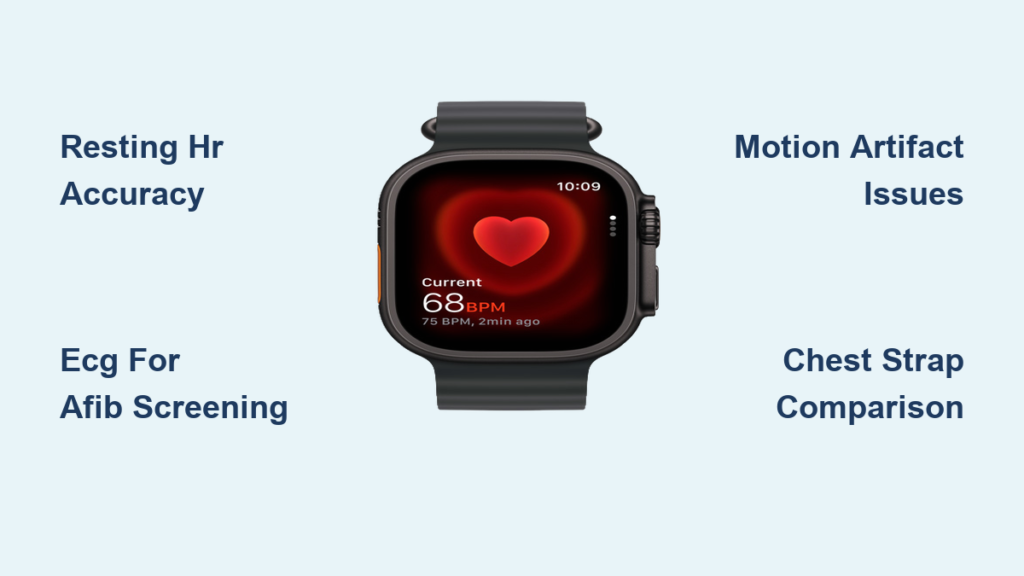
If your Apple Watch flashes a warning about an unusually high or low heart rate, should you take it seriously? Millions of users rely on its heart rate monitoring for fitness tracking, recovery insights, and even early warnings of serious cardiac issues. But how reliable is Apple Watch heart rate data—especially when your health may depend on it?
Backed by advanced sensors and FDA-cleared tools, the Apple Watch has become a cornerstone of personal health technology. It uses photoplethysmography (PPG) for continuous heart rate tracking and electrocardiography (ECG) for rhythm analysis. While clinical studies show strong accuracy in controlled environments, real-world performance varies based on activity, physiology, and device generation.
This guide breaks down the evidence: from peer-reviewed research and meta-analyses to real-world user reports and known limitations. You’ll learn exactly when to trust your Apple Watch—and when to verify with medical-grade tools.
How Apple Watch Measures Heart Rate
PPG vs. ECG: Two Different Systems, One Goal
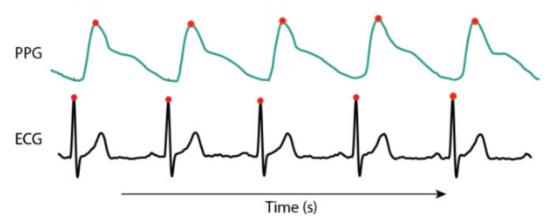
The Apple Watch uses two distinct technologies to monitor heart activity:
- PPG (Photoplethysmography): Optical sensors use light to detect blood flow under the skin. This system provides continuous heart rate (BPM) tracking throughout the day.
- ECG (Electrocardiogram): An electrical sensor activated by touching the Digital Crown. It measures the heart’s electrical signals and is FDA-cleared for detecting atrial fibrillation (AFib) and other arrhythmias.
⚠️ Important: PPG tells you how fast your heart beats. ECG reveals how regularly it beats. They serve different purposes and should be used accordingly.
Inside the Optical Sensor: How PPG Works
The back of the Apple Watch contains green, infrared, and red LEDs that work with photodiodes to detect changes in blood volume:
- Green LEDs (~525 nm): Most accurate for heart rate; used during workouts and manual checks.
- Infrared LEDs (850–940 nm): Run passively in the background for low-power monitoring.
- Red LEDs (660 nm): Enable blood oxygen (SpO₂) readings on Series 6 and later.
Accuracy depends heavily on which mode is active. Foreground tracking, like during a workout, delivers far more reliable data than passive background readings.
✅ Pro Tip: Always start a workout session for the most accurate optical heart rate measurement.
Accuracy by Activity and Condition
Resting and Daily Monitoring: Highly Accurate
For resting heart rate and long-term trends, the Apple Watch performs exceptionally well:
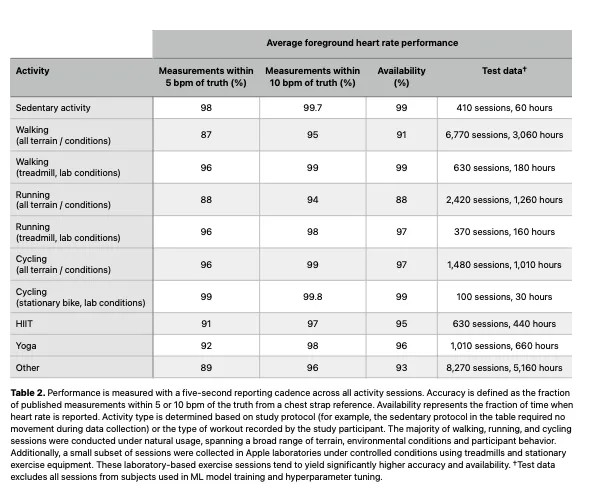
- 98% of readings within 5 BPM of clinical devices
- Mean bias: +0.21 BPM at rest
- ICC (Intraclass Correlation) = 1.00 in cardiac patients during mild activity
This makes it ideal for tracking cardiovascular health, sleep quality, and recovery from illness or overtraining.
✅ Use Case: Detecting a gradual rise in resting heart rate—often an early sign of infection, dehydration, or overtraining.
Exercise: Solid, But With Limitations
During physical exertion, accuracy remains good—but not flawless:
| Activity Type | Accuracy (Within 5 BPM) |
|---|---|
| Walking, jogging | 92% of the time |
| Cycling (road) | 85% |
| HIIT / Intervals | Lags during rapid HR changes |
| Rowing / Elliptical | Signal drops common due to motion |
High-vibration or repetitive-arm-motion activities often disrupt the optical signal.
📉 Example: Users frequently report spikes to 180 BPM during moderate runs despite feeling fine—likely due to motion artifact or signal noise.
Peak and Recovery Heart Rate: Handle with Care
While average exercise heart rate is generally trustworthy, peak HR readings can be off by 30+ BPM compared to chest straps.
- One study found the Apple Watch underestimated peak HR by up to 15 BPM
- Heart rate recovery (HRR) is tracked reliably—valuable for assessing fitness improvements
💡 Tip: For elite training precision, pair your Apple Watch with a chest strap like the Polar H10.
Clinical Accuracy: What Research Says
Cardiac Patients: Surprisingly Trustworthy

A 2023 study of 260 male cardiac patients found:
- ICC = 1.00 for heart rate vs. Polar H10 and pulse oximeter
- Mean difference: +0.01 BPM
- Valid across both regular and irregular rhythms
This suggests the Apple Watch can support post-event cardiac monitoring—especially when used under medical supervision.
Atrial Fibrillation Detection: Useful, But Not Perfect
In a Cleveland Clinic study of 50 post-op patients:
- Lin’s concordance rc = 0.70 (moderate agreement)
- Accuracy was higher in AFib (rc = 0.86) than in normal rhythm
- Some readings were off by up to 40 BPM
- One patient had no ECG recorded
⚠️ Bottom Line: The ECG app is excellent for screening—but not diagnostic. Always confirm findings with a physician.
SpO₂ and Oxygen Monitoring: Reliable at Rest
Apple Watch Series 6+ includes blood oxygen sensing:
- ICC = 0.98 at rest, drops to 0.85 after exercise in arrhythmia patients
- No significant difference between skin tones (p = 0.498)
Useful for spotting trends, but not for diagnosing hypoxia.
Compared to Other Devices
Apple Watch vs. Chest Straps
| Metric | Apple Watch | Polar H10 (Chest Strap) |
|---|---|---|
| Resting HR | ±2–3 BPM | ±1 BPM |
| Exercise HR | r = 0.85 | r = 0.99 |
| Latency | Slight delay | Real-time |
| Comfort | Wrist-worn | Requires chest band |
Chest straps remain the gold standard for athletes needing precision.
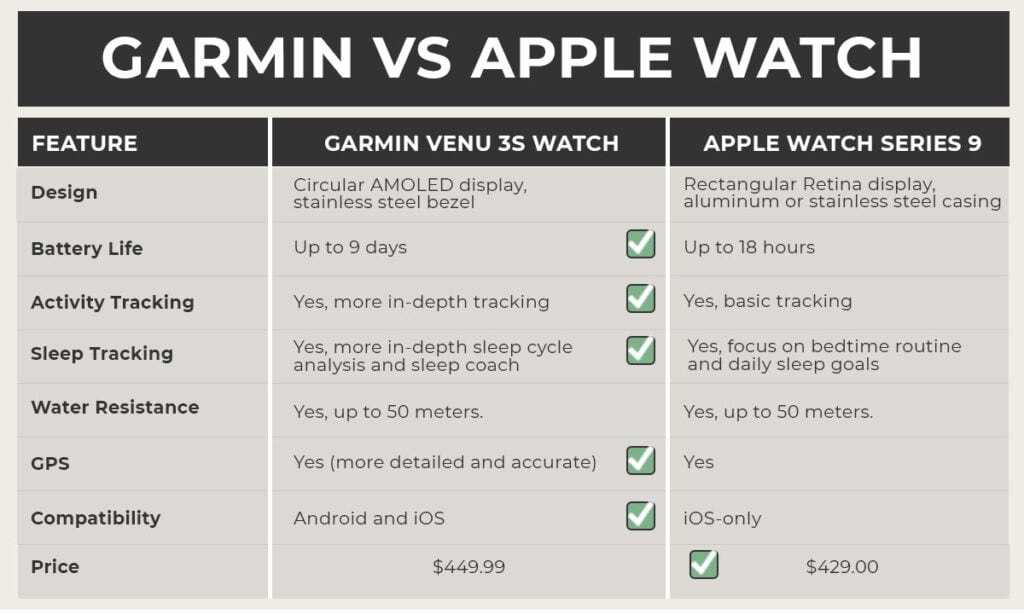
Apple Watch vs. Garmin, Whoop, Scosche
| Device | Best For | Limitations |
|---|---|---|
| Garmin (optical) | Motion resistance | Less consistent in low perfusion |
| Whoop | HRV and recovery | No ECG or SpO₂ |
| Scosche Rhythm+ | Cycling, rowing | Arm band only |
| Apple Watch | Daily health + ECG | Struggles with overhead movements |
🎯 For most users: Apple Watch offers the best balance of features and accuracy.
Factors That Reduce Accuracy
Poor Fit and Placement
Wearing the watch too loose is the #1 cause of inaccurate readings.
- Ideal fit: Snug, about 1–2 cm above the wrist bone
- Too loose: Causes motion artifacts
- Too tight: Restricts blood flow
✅ Pro Tip: Switch to a nylon or performance band for better grip during workouts.
Skin and Physiological Barriers
| Factor | Impact |
|---|---|
| Tattoos | Ink blocks light—common cause of signal loss |
| Body hair | Interferes with sensor contact |
| Cold hands | Reduced blood flow impairs PPG |
| Low perfusion | Seen in elderly or vascular disease patients |
Moistening the skin or trimming hair can improve signal quality.
Activity-Specific Challenges
Overhead Exercises (Pull-ups, Dips)
- Blood flow to wrist decreases
- Watch often shows “poor signal” or grayed-out readings
- Acceptable—focus on post-workout summary
Rowing and Elliptical
- Repetitive arm motion creates vibration
- Takes 3–5 minutes for signal to stabilize
- Consider upper-arm sensor for better accuracy
Cycling (Especially Mountain Biking)
- Handlebar vibration disrupts optical sensor
- Use Scosche Rhythm+ or chest strap for reliable data
Real-World User Experiences
When It Saves Lives
Multiple users report life-saving alerts:
- ZipitOrRipit: Watch detected dangerously low HR → pacemaker implanted
- shaggys6skin: Resting HR 38–45 BPM → diagnosed with bradycardia
- WhichStatement4156: HR of 42 BPM vs. normal 80–100 → medical follow-up
These cases highlight the value of continuous monitoring, even with occasional errors.
When It Fails
Common complaints include:
- Persistent high HR at rest (e.g., 126 BPM) despite normal ECG
- Erratic spikes during moderate runs
- Delayed readings on rowing machines
- Inconsistent data on Apple Watch Ultra 1/2
Some issues may stem from firmware bugs or sensor calibration problems.
🛠 Fix: Reboot, clean sensor, reposition, or update software.
Maximizing Accuracy: Best Practices
Wear It Right
- Position: 1–2 cm above wrist bone
- Tightness: Snug but comfortable (one finger under band)
- Skin prep: Wipe clean, add water if dry
- Avoid tattoos or hairy spots
Use the Right Mode
- Start a workout for most accurate optical HR
- Manual ECG check if you feel palpitations
- Check SpO₂ if short of breath
Background monitoring is less precise—don’t rely on it for training zones.
Know When to Supplement
| Scenario | Recommended Solution |
|---|---|
| Cycling / Rowing | Scosche Rhythm+ arm band |
| HIIT / CrossFit | Polar H10 chest strap |
| Medical concern | Confirm with ECG or Holter monitor |
| Persistent odd readings | Consult cardiologist |
Limitations and Risks
Not a Medical Device
Despite FDA clearance for ECG, the Apple Watch is not approved for continuous cardiac monitoring.
- PPG cannot replace ECG for detailed diagnosis
- False positives may cause anxiety
- False negatives could miss serious events
❗ Never ignore symptoms just because your watch says you’re fine.
Software Bugs and Glitches
Known issues include:
- Stuck high HR (e.g., 126 BPM at rest)
- Overestimation during elliptical (user’s Holter showed normal)
- Firmware bugs in early Ultra models
If readings don’t match how you feel, restart the watch or see a doctor.
Final Verdict: Is Apple Watch Heart Rate Reliable?
✅ Trust It For:
- Resting heart rate trends
- Daily activity and fitness tracking
- Heart rate recovery and HRV
- AFib screening via ECG app
- Early warning of extreme HR changes
⚠️ Question It During:
- High-intensity interval training
- Cycling, rowing, or elliptical
- Overhead or dynamic arm movements
- Arrhythmias or poor circulation
- Persistent abnormal readings without symptoms
Best Use Cases by Need
| Goal | Recommended Approach |
|---|---|
| General health tracking | Apple Watch alone — highly reliable |
| Training precision | Pair with chest strap |
| Cycling performance | Use arm band (e.g., Scosche) |
| Arrhythmia screening | Use ECG app + doctor follow-up |
| Medical monitoring | Validate with clinical tools |
The Apple Watch heart rate monitor is reliable for most everyday purposes, backed by strong research and real-world success stories. With a mean error under 1 BPM and excellent correlation in clinical studies, it’s one of the most accurate wrist-based devices available.
But it’s not perfect. Motion, fit, physiology, and software issues can reduce accuracy—especially during intense or irregular activities. For athletes and medical patients, pairing it with a chest strap or clinical test ensures confidence.
For the average user? The Apple Watch delivers exceptional value: a powerful, convenient tool that can track health trends—and sometimes, save lives. Just remember: it’s a guide, not a diagnosis.